
Selling Your Company:
Finding Your Special Sauce

Hamburger

To Maximize Shareholder Value, Find Your Special Sauce

At some point, most business owners will ask “How do I sell my business?”. And “How do I prepare my business for sale?” The earlier these questions are answered, the greater the wealth that the owner will accumulate over their life.

The vast majority of businesses are sold once in a lifetime. And many aren’t even sold then, and span generations. As a business owner, when you sell your company, you are venturing into an area where your experience is limited. There are exceptions, but for the majority of owners of middle market companies, a sale is a once-in-a-lifetime experience, and you are at the disadvantage.


By comparison, the buyers are experts, and it is their business to buy businesses. This creates a disparity of knowledge and understanding about what what makes a company an attractive acquisition candidate (aside from a disparity in skill in the M&A process). The challenge to the business owner is that he/she doesn’t actually know what the buyers want. They likely know the market for their products very well, but they commonly don’t really know the market for their company.


Try thinking about your company as a consumer product, like a hamburger. There are other competing product offerings – hamburgers – on the market, each with their own attributes: size, flavor, texture, type of bun, condiments, weight of the beef patty, packaging, price and experience consistency. Has your company been positioned to attract customers? That is, is the design of your hamburger specifically addressing the needs of your consumer based upon market research?


Depending on whether your company was developed with an exit in mind, the sale process might be measured in single-digit months if it is well prepared, or measured in years if it needs repositioning. If its poorly positioned, it could also end up as a liquidation. Which direction the exit takes depends whether the company was created to attract buyers.


Here are a few attributes financial buyers look for:

1) The company runs itself

2) It’s scalable

3) It has a defensible niche or other competitive advantage


Companies that run themselves have good management that are independent of the owner. A marker of this is whether the owner can go on vacation without worrying about what is going on back home. To do this, the company needs a sales manager and top salesman, neither of which are the owner. The company has a head of operations that is grooming their own successor. And it has strong financial management capable of standing its ground against the VP of Sales (and the owner).


A company that runs itself has invested in its people and processes. Policies and procedures are codified. It has systems, controls, and key performance indicators that are compared regularly to actual results. There are best practices that have been put in writing. Training is passed from more senior to less senior people, and jobs are cross-trained.  The company is not dependent on any one person.


A company that runs itself has a long-term plan. The plan determines – by default – the company’s priorities and activities in the short term and medium term. The energies of the company are focused and used efficiently, since they are not wasted due to conflicting goals. The long-term plan also matters because financial buyers will own the company for about 7 years, and will sell it to someone else that may own it even longer. As a result, the buyer is looking out at least 14 years, because he is going to be facing his own buyer in 7 years. That is the vision the company has to try to take into account in forming its strategic plan. In addition, the company has stayed abreast of technology and other industry developments, because 15  years is a long time and getting behind the curve can be quite fatal.


Scaleable companies are lean and have a flexible design that permits growth without a requisite increase in costs. The systems, training programs, and sales effort can be ramped up and result in an increase in EBITDA margins. The company has a management team that can handle growth as-is, or it has a system to efficiently train and expand its human capital.


Companies with a defensible niche know their customer, their competitors, their suppliers, their industry, and most importantly, themselves. They have thoughtfully analyzed their own profitability, where they make their highest margins, where they can obtain the greatest return on capital, where the long term growth of the market will come from, and how they will position themselves for it. The company has created itself around a unique capability, and it’s not quite like any other company in this regard. This is their special sauce, and buyers seek acquisitions that have one.


If you don’t sell your company to a financial buyer, then it’s even more important to have a special sauce. Strategic buyers are interested in that certain indescribable something, je ne sais quoi. It may be a technology, process, knowledge, market, or something else altogether.  It is certainly a form of Intellectual Capital.  That is a certainty because tangible assets can be acquired anywhere.


The special sauce of one company was its new product development process. The company had been in workout at two banks in a row, and had a nearly valueless equity position. As a last attempt to survive, it brought in a new president who transformed it. But the key was that he put in place a new product development model that eliminated the bottom one-third of their products every year and created a new third. Not only did this create variety for the consumer, it allowed greater pricing strength with his distributors. In just a few years, the equity value of the company went from virtually zero to $40 million when it was sold to a strategic buyer who valued it as much for its new product development model as for the rest of its attributes.


The takeaway is that you need to know what prospective buyers of your company want, and then create a special aspect of your company to meet their needs. You need to do that with your company just like you do in creating the deliverables for your own customers. To learn more about exit planning and mergers and acquisitions, contact us.

by Charles Smith

Mr. Smith is the founder of Pegasus Intellectual Capital Solutions, a boutique investment bank specializing in mergers and acquisitions, Capital Raising and restructuring and workouts. The firm is an innovator in the use of Intellectual Capital Audit for pre-closing due diligence and in turnarounds. Charles can be reached at csmith@pegasusics.com

See also: Preparing a Company for Sale
 

Selling Your Company Yourself?

Mission Impossible Mouse Trap

It can be done, but it is not for the unaware…


A question I hear often from privately held business owners is “Why do I need anyone to help me sell my company? I already have buyers wanting to buy it now.” The answer is related to an imbalance in experience, information and human resources. The outcome is that owners get less if they sell their companies themselves, according to recent research by Fairfield University


Think about selling your house. This is generally the most valuable asset for any household, and the second most valuable for a privately held business owner. I have had people offer to buy my house. Thus, like the privately-held business owner, I have interested buyers. But do I believe for a moment that this is the best price I can possibly receive? If I listed the house with a real estate broker, what are the odds that one of these people would end up being the high bidder? I think the odds are low. And, how do I run the rest of my life while I prepare my house for sale and go through the very time consuming process of talking to and negotiating with buyers?


Selling a house is very, very simple compared to selling a company. You can benchmark a house based on comparable transactions, whereas no two companies are alike in any similar way. Companies have liability issues, potential litigation, customer concentration, product concentration, HR issues, succession management issues, and technology risks. The due diligence lists of sophisticated buyers is in the order of 35 pages long. Here is what one looks like: M&A checklist The buyer’s due diligence team will include their attorneys, accountants, and their lenders with their field auditors. I regularly see buyer’s due diligence costs total $350,000 for a middle-market company.


Obtaining fair market value requires (1) a professional description of the asset from the buyer’s standpoint, and (2) contacting sufficient potential buyers to assure that you have competition and statistical reliability that you have canvassed the market. Private equity firms make a living by contacting business owners and negotiating one-off deals. Strategic acquirors do the same thing and commonly want just a brand, product formulation, process, or customer base and are unwilling to pay for the infrastructure and other valuable intangibles you have created. Sell to one of these buyers and you are selling just part of your company’s value.


Private equity firms and larger strategic investors are professional buyers. They have internal or retained legal counsel specializing in mergers and acquisitions, databases of recent M&A transactions that they can use as comparables, a staff of analysts gifted in industry and economic research, and the ability to marshal internal human resources to simply force an outcome through superior effort.


Privately held business owners are most often first-time sellers. Compared to PE firms, this is a profound inequity. The business owner has a full-time job running their company. The sale process is very time consuming. Putting together the historical financial information, formation papers, customer and supplier information, historical data on sales by SKU by customer, information on tangible assets… the due diligence list goes on ad nauseum at times. Do this by yourself and prepare to be overwhelmed.


The business owner will be holding down two jobs: running their company and selling their company. Business owners are fully-employed just running their company. The buyer has the advantage of superior knowledge, superior human resources, and the ability to wear down the seller over time. The buyer will request what seems like a never-ending stream of information, and will emphasize and drill-down into the ever-present weaknesses of the company as a detriment to value. In time, the buyer will fatigue the seller. The seller would like to cancel the transaction, but is now too tired to start the sale process all over again. The buyer generally wins this battle.


There are numerous ways for a privately held business owner to get less than they deserve. A few include a lack of competition in the bidding process, liabilities which must be assumed by the seller, assets which are not included in the sale (both tangible and intangible, i.e. intellectual capital), tax liabilities, potential future liabilities, post-closing working capital adjustments, and the list goes on.


An M&A professional will protect the seller from being distracted from day-to-day management and becoming fatigued. The investment banker will assist in organizing due diligence materials ahead of time, and ensure that enough potential buyers are contacted to assure that the odds are low of any higher prices being unidentified. The investment banker will protect the seller from obscure but potentially deleterious provisions in the purchase and sale agreement including post-closing items. The investment banker will protect the seller from obscure but potentially deleterious provisions in the purchase and sale agreement including post-closing items.


The challenge is that we don’t know what we don’t know. To counter that, talk to business owners that have sold their company. Chat with an experienced M&A attorney both for advice and referrals to business owners who have sold. Learn as much about the process and what to expect as you can. Then decide for yourself.


By Charles Smith


Charles Smith is the founder and Managing Partner of Pegasus Intellectual Capital Solutions, a Chicago based boutique investment bank engaged in mergers and acquisitions, capital raising, and restructuring and workouts. PegasusICS is the creator of the Intellectual Capital AuditTM, a methodology to identify how knowledge is used within a company how it creates wealth, and how it affects corporate governance. The firm was voted 2013 Boutique Investment Bank of the Year by Acquisition Finance Magazine. You can learn more by clicking here.


Google+ PegasusICS on Google+


International Trade:
A Key to Maximizing Value

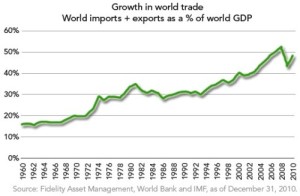
Trade has grown dramatically in international importance

Trade has grown dramatically in international importance

International trade has become increasingly important over the last several decades. Trade as a percent of global GDP has steadily risen from 20% of global GDP in the early 1970’s to just 50% of global GDP today. One’s first reaction might be that service providers can stop reading now, because only goods – physical products, raw materials, etc. – are exported or imported. Not so.


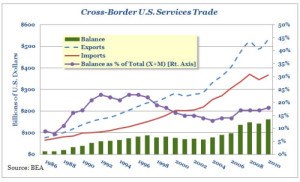
U.S. exports of services have escalated dramatically.

U.S. exports of services have escalated dramatically.

The fascinating part of the story is that the increase in trade also involves services. Unless a business is looking overseas or across borders for both sourcing and selling, it may be missing out on opportunities for growth or cost reductions.


Commercial construction – one of the seemingly most local of businesses – is even a candidate for international trade. I learned of this when an attorney at a Chinese firm approached me about introducing their client – a giant Chinese construction firm – to U.S. construction companies to joint venture on U.S. construction projects. As it turned out, the Chinese government had given cheap loans to their industry, and they were now using this as leverage to provide financing for commercial and municipal construction projects in the U.S.


One common misconception is that only larger companies import and export. One company I know makes high precision parts using highly specialized materials. Their secret sauce is their chemistry. They manufacture and ship one specialized product to one of the most famous luxury product manufacturers in Europe. They do this and still obtain 20% EBITDA margins. They also source some of their supplies from inland China. How big are they? About $5 million in sales. This is all possible due to the Internet.


The Internet also makes ecommerce possible. But many business owners believe that only consumer products are sold on-line. Yet one company I know has been very effective at selling industrial products on Amazon.com. I understand why. Finding industrial goods in small quantities or that are very specialized or infrequently purchased can be difficult and time consuming. Local suppliers are commonly set up to service only much larger orders. Google search, Amazon.com and EBay makes ecommerce possible.


If you have a unique product that is high-value relative to shipping costs, the world is your oyster. Ecommerce eliminates borders, and eliminates your geographic limitations, subject only to shipping costs. As a hobbyist, I needed a very specific diameter of pipe with a very specific wall thickness. I found exactly what I needed, in aluminum, on Amazon for about $57. It probably cost the manufacturer a few dollars. I could care less, because it saved me so much time looking fruitlessly locally.


With Internet search at our fingertips, accounting services, banking services, call centers, software programming, engineering, design, graphic arts, and IT are all bought and sold internationally. And, by the way, so are investment banking services including cross-border mergers and acquisitions, and capital raising. If you want to learn more, contact us

by Charles Smith

Mr. Smith is the founder of Pegasus Intellectual Capital Solutions, a boutique investment bank specializing in mergers and acquisitions, Capital Raising and restructuring and workouts. The firm is an innovator in the use of Intellectual Capital Audit for pre-closing due diligence and in turnarounds. Charles can be reached at csmith@pegasusics.com


The Many Flavors of Company Buyers

Ice cream sundae with many flavors

Some flavors are simply better than others

Company owners are commonly bombarded with unsolicited expressions of interest in buying their company. Some are real and some are not. Some are very good guys. Most of the rest are decent people, but money is a weakness for many, one of the seven deadly sins. That leads to the rest. How do you know who is who?


The world has changed in the last 35 years. In 1979, when I started my career, Private Equity Groups (PEGs) didn’t really exist, certainly not in the middle-market or lower middle-market. When they did emerge, they were called buyout firms, or LBO funds or LBO firms. They used financial engineering , primarily financial leverage, to get their required return on investment. And then there were the asset sales that broke the company up into parts to reduce debt quickly. Those days are long gone. The low hanging fruit of yore – the under-managed company – has long since disappeared. The increasing efficiency of the large corporate and middle market is forcing PEGs to look at smaller companies and focus on operating skills rather than financial engineering.

Today we see PEGs, Family Offices, Strategic Acquirors, Fundless Sponsors, Pension Funds, and international strategic acquirors all as possible buyers for companies. Even within each of these categories, there are a number of varieties.

PEGs have segmented into industry/sector specializations, control versus minority position, and active versus passive management. There are funds that specialize in minority, typically passive, positions. We see a growing specialization in Oil & Gas, Healthcare, IT, Technology, and Agribusiness/Food segments. New specializations sprout up with alacrity, such as funds focused on companies in the Sustainable/Cleantech space. PEGs use OPM (other people’s money) and have roughly a 7-year time horizon before they will resell the companies they acquire.


In addition to their equity funds, many PEGs now often have pure debt funds and debt-with-warrants funds that permit recapitalizations of companies where the owner wants to take cash off the table but not cash out. These funds sprouted up to offer a high fixed yield to investors in the post-financial crisis period. The debt funds usually have a 5-year period before they exit. Most funds are guys in white hats, but some wear black hats, and use the debt as a call option on the stock of the company or its assets. It’s important to know who is who.


Family Offices are invisible to many. They prefer it that way. From the outside, they may look like any other PEG. They are high net worth families with assets in the hundreds of millions or billions of dollars and manage their wealth much like a PEG would, except it is their money. These families usually created their wealth building a company that was sold at some point in the past. They oft times have valuable skill sets to bring to the table, and have longer time horizons over which they invest, sometimes infinite. Most family offices are nice people, but it is very uncommon for them to reach out to a company owner themselves.


Strategic Investors can be broken into two categories: you direct competitors and everyone else. Competitors commonly want to steal your trade secrets: customer lists, manufacturing processes, or some other secret sauce. If they don’t want to steal your trade secrets, they want to steal your people, or something else you have. Unless you have built the Chinese Wall in your sector, their only goal is to put you out of business. If you have built the Chinese Wall of your sector, don’t let them through the gates.

Non-competitors are usually large companies looking to sell into your customer base, use your products to sell into their distribution systems, or some other strategic reason. If the non-competitors are large, as in a billion in sales and publicly traded, they may offer the highest sale price.

Large Strategic Investors’ scale creates safety through diversification of products, customers, geographic markets, and management. When they acquire your company, they usually fold you in, eliminate your corporate overhead, and get a positive bump in their stock price. The best of these buyers are experts at what they do, buy companies regularly and understand merger integration. If they don’t, it is best to be cautious.

Fundless Sponsors are a bit of an odd duck, and quite likely to call or write to you to buy your business. A Fundless Sponsor is someone that does not have their own capital to invest. They have to raise capital for every deal they do, and are rarely the people that will run the deal or the company. The control party is the one with the actual equity in hand. The universal truth is that Fundless Sponsors are looking to buy a company off-market and below market value. Some Fundless Sponsors are very professional, but some are not, and can waste a lot of people’s time and money in the sale process.

Some Fundless Sponsors paint themselves as either a PEG or an investment bank. If they position themselves as the former, they are deceitful. If they position themselves as the later, they have conflicts of interest. If you work with a good investment bank, there is no need to work with a Fundless Sponsor, as it is far more productive to take the transaction straight to the ultimate acquirors. A good investment bank does not buy companies or have a fund. That is a red flag, and a huge conflict of interest.


Pension Funds have started to do direct investing in recent years. Traditionally, they have invested in the funds that PEGs operate. Some Pension Funds are huge, such as CalPERS (California Public Employees’ Pension System), and very long term in their approach. Pensions are nearly universally good guys, but to date, I have never heard of one calling or writing a privately held business owner to acquire it.


International companies can be attractive acquirors, particularly if you have a customer list or distribution system that helps them access the US market without having to build it themselves. Sometimes they want your technology. The way they do business is dependent on their culture and business culture, and they are many times so different from those of US companies that we may as well be from different planets.


Regardless of who wants to buy your company, it’s important to remember they are professional acquirors, have dozens of deals under their belts, and want to buy you for less than you are worth. Getting someone in your corner evens the odds, and permits the creates the kind of competition that brings results.

Position Your Company
for Sale as a Platform

Building Columns

You must build a solid foundation if you want to sell your company as a platform company.

If you want to sell your company, be sure that it is viewed as a platform company by private equity groups. PEGs commonly view an acquisition in a new industry or space as a “platform” company. That is, they intend for the company to grow organically and have add-on or tuck-in acquisitions to create synergies. At the time of the acquisition of a platform, the PEG does not have an existing portfolio company to combine with it that would yield synergies. You want that platform company to be yours.

Platform companies stand in contrast to “add-on” or “tuck-in” acquisitions where synergies to an existing portfolio company are believed to exist. Estimates vary across sources, but add-ons constitute roughly 40-50% of PE buyout activity, making it critical for business owners who are thinking of taking a private equity investment to understand some of the strategic implications of both views. Add-on and tuck-in acquisitions are usually considerably smaller companies so as to not dilute the culture of the platform. Add-ons and tuck-ins are acquired for lower EBITDA multiples. Think 3x.

In academia, Platform companies are those that involve not only one company’s technology or service but also an ecosystem of complements to it that are usually produced by a variety of businesses. As a result, becoming a platform leader requires different business and technology strategies than those needed to launch a successful stand-alone product. There are two fundamental approaches to building platform leadership – “coring” and “tipping.” If you really want to make a lot of money, position yourself as a platform company that uses a coring or tipping strategy.

“Coring” is using a set of techniques to create a platform by making a technology “core” to a particular technological system and market. When pursuing a coring strategy, would-be platform leaders think about issues such as how to make it easy for third parties to provide add-ons to the technology and how to encourage third-party companies to create complementary innovations. Examples of successful coring include Google in Internet search and Qualcomm in wireless technology. “Tipping” is the set of activities that helps a company “tip” a market toward its platform rather than some other potential one. Examples of tipping include Linux’s growth in the market for Web server operating systems. Another tipping strategy is for a company to bundle features from an adjacent market into its existing platform. This is referred to as “tipping across markets.”

In common usage of the term, PEGs conisder platform companies to be those which have sufficient economies of scale, and talent acquisition, talent management, and succession planning capabilities upon which it can effieciently add add-on or tuck-in acquisitions. PEGs seek to acquire companies that they can grow or improve (or both) with a view toward eventual sale. In terms of growth, the financial sponsor will usually acquire a platform company in a particular industry and then seek to add additional companies to the platform through acquisition. These add-ons may be competitors of the original platform company or may be businesses with some link to it, but they will be added with the goal of increasing the overall revenues and earnings of the platform investment.

PEGs spend a great deal of time developing strategic plans and an investment case for a new platform to determine why they are buying a business and how they will generate an attractive return. This analysis is usually even more comprehensive for businesses that are new to a PEG. For add-on acquisitions, PEGs sometimes lean more on the expertise of its relevant portfolio company’s management to determine the fit, synergies and strategic benefits of a transaction. That is why the talent acquisition, talent management and succession planning are so important.

For new platforms, PEGs require that the company not only be self-sustaining, but be scaleable. The ability to grow the company is the rationale behind the deal, and it defines how the PEG will create value through things like capital infusions, operating partners and future add-on acquisitions. The PEG seeks avenues of growth to maximize value of the investment. For new platforms, PEGs focus on issues including industry attractiveness, the opportunities for growth, the self-sufficiency and scalability of the target, and and whether the PEG can add value in the acquisitions process.

To be self-sufficient and scaleable, the target must be able to prosper without any one individual. Customers must be “owned’ by the company, not one person, and certainly not the current owner. Critical processes must be mapped, and the organization must be in a highly efficient.

If you are a business owner, ensure that you have created a company that can prosper without you, that is self-sustaining, and has the talent in place to take it to the next level without you. That is your path to greatest wealth.

To learn more, contact us.

by Charles Smith

Mr. Smith is the founder of Pegasus Intellectual Capital Solutions, a boutique investment bank specializing in mergers and acquisitions, Capital Raising and restructuring and workouts. The firm is an innovator in the use of Intellectual Capital Audit for pre-closing due diligence and in turnarounds. Charles can be reached at csmith@pegasusics.com

Increasing Your Company’s Value With Benchmarking

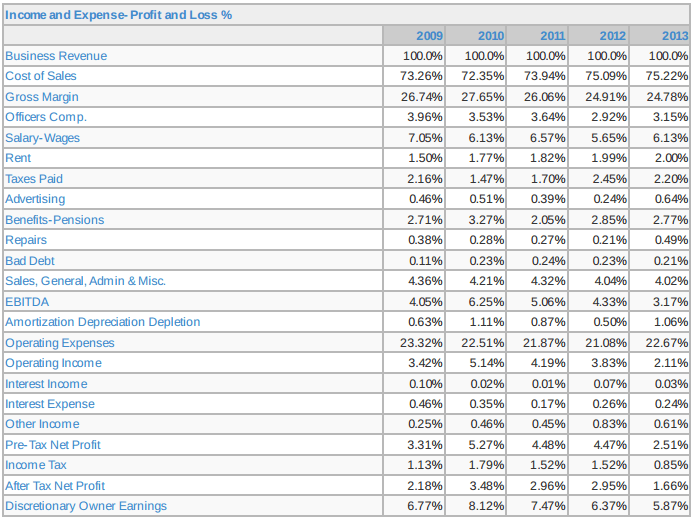
Common Sized Income Statement

If you don’t know where you are, how can you know where you are headed?

Benchmarking your company against your industry peers helps you identify your strengths and weaknesses. It points you in the direction to increase the value of your company.

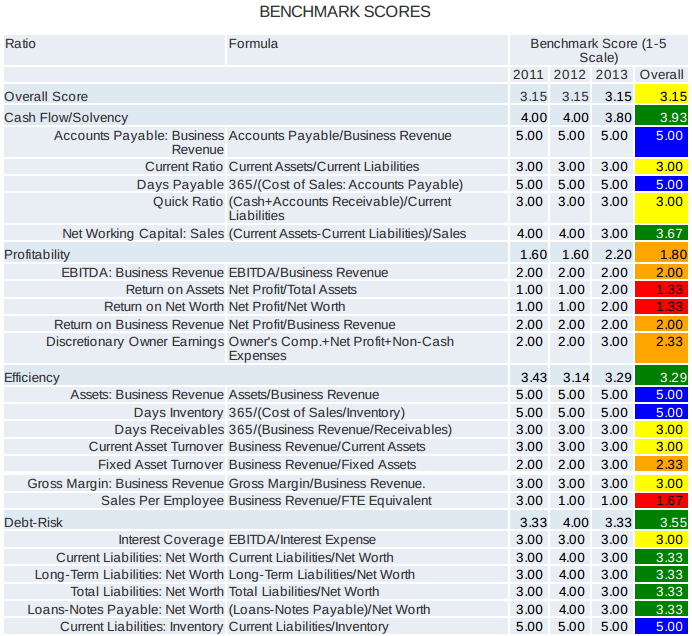
Benchmarking your company using common-sized income statements and balance sheets is the single most important you can do to understand the value and salability of your company. We use common-sized financial statements in all our engagements, including M&A, valuation, capital raising and turnarounds. They quickly tell us where a company ranks compared to competitors.

“Common-sizing” is taking a financial statement and putting the number in percentages. In the case of the income statement, you take each line item and cast it as a percentage of sales. In this way, you can see at a glance how each expense category compares to sales. By putting your data year-by-year, you can easily detect changes and trends. Graphing the data makes the changes all that more clear. With this in hand, you can determine if you have a competitive advantage or disadvantage.

“Competitive Advantage” is technically defined as a 2 point advantage in EBITDA margin (Earnings Before Interest, Taxes, and Depreciation as a percentage of sales) compared to industry averages, e.g. 10% versus 8% industry average. There are vast differences in the EBITDA margins of companies, and between the various industries and company sizes. You always want to compare yourself to your industry. You may or may not want to compare yourself to just companies of your comparable size, as you are usually competing against the largest players unless you have geographical – or other – barriers to entry.

Your EBITDA margin advantage (or disadvantage) tells us where a company would fall in the comparable sales transaction EBITDA multiple observations, ceterus paribus. If a company’s industry comps show that companies in its space have fetched multiples of 4-10x EBITDA with an average of 6x, and the company’s EBITDA margins are 2 points better than industry average, we expect that this company would sell at the high end of the EBITDA multiple range.

This outcome results in a higher sale price at any given nominal dollar EBITDA level. Keeping an EBITDA margin advantage is mission critical if you want a good sale price. The buyer can ill afford to scale up a company that is just average, or worse, below average. It only makes sense to scale up a company that is superior to its peers.

Common Sized Income Statement

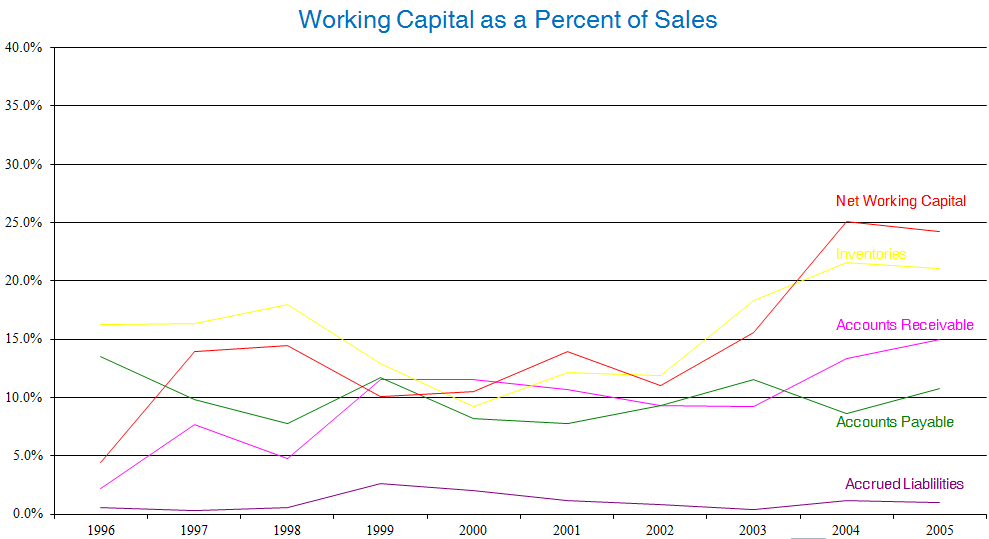
Benchmarking goes well beyond the income statement, however. We use common sized income statements to look at working capital efficiency. Here, we calculate receivables, inventory, payables and accruals as a percent of sales. If we see rising percentages over time, it is a cause for alarm. We saw this trend prior to the financial crisis in the building products sector. The underlying cause was the slowing of payments by home builders to their suppliers.

Common Sized Income Statement

An out of control working capital increase that makes growth infeasible.

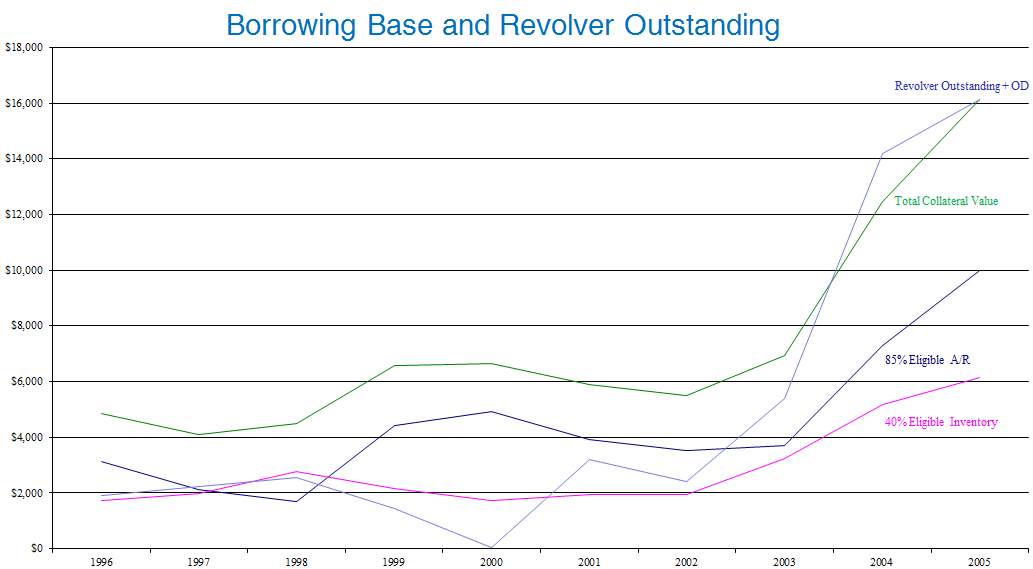
We also saw a disconcerting increase in working capital utilization by a manufacturer in the building products space. The long term trends indicated that continued revenue growth would not be financeable and that the company was headed towards a liquidity problem. This company listened to us, and accepted an offer to be acquired by a much larger competitor.

Working Capital effect on revolver outstandings Graph

Revolver availability tapped out due to unconstrained increases in working capital.

The challenge in using common-sizing is interpreting the results. There are commonly more than one possible interpretation, and it takes experience and use of other data to determine the underlying causes. As but one example, lower EBITDA margins over time, combined with rising working capital as a percent of sales could indicate an increasingly competitive pricing environment, or a company’s willful easing of pricing and sales terms to capture market share. If EBITDA margins continue to be above industry average, the later interpretation is a positive. If EBITDA margins are at or below industry average, this would be considered a negative and would negatively impact company value.

Common Sized Income Statement

A common sized balance sheet

You can use benchmarking to determine both your competiveness and salability, as well as a diagnostic tool to determine what needs to be changed (or not changed) about your company If your EBITDA margin is below industry average, common-sizing will quickly point to problems in your cost structure. After that, a re-engineering project is called for to ensure your supply chain is optimally designed.

One word of caution is in order. Your cost accounting and financial accounting have to be very good. Costs have to be accurately allocated. If you have multiple products, costs have to be allocated to each product. We commonly find that the quality of financial data of companies without audits is inadequate to make meaningful decisions. A re-engineering of the accounting and finance functions then become the first order of business. Without high quality cost accounting and financial accounting information, we are just flying blind.

If you are interested in benchmarking your own company or want to learn more about benchmarking using common-sized financial statements, please contact csmith@pegasusics.com.

Shareholder Value
Managing Talent is the Key

Man pulling shirt open like Superman

Talent acquisition, talent management and succession planning are the keys to the ultimate creation of Human Capital and Shareholder Value Maximization.


The creation of enterprise value, the key to shareholder value maximization, is primarily dependent on the creation of Human Capital.  That has been my conclusion for some time, and according to Andrew McKenna, Chairman of McDonald’s Corporation, whom I heard speak this Tuesday, it seems to be his opinion too.


Mr. McKenna identified three key roles for the board of directors:  Succession planning, talent acquisition and talent management.  Without these, an enterprise has no viable future.  With these, in time it will build the Structural Capital and Relational Capital it needs to prosper.


Lower middle market companies commonly suffer from a key man (or woman) issue.  This is really just a lack of succession planning.  To build a valuable enterprise, we must hire, train, and nurture our successors.


In his first job, Mr. McKenna went to his boss to resign.  His boss asked why.  Mr. McKenna said he wanted to start his own company.  His boss asked what kind.  McKenna said, the same as yours, I’m going to be your competitor.  His boss asked who was going to finance it.  McKenna said he thought he could find financing.  His boss said, let me finance it.  McKenna asked why.  His boss said, I want you to be successful so you can buy my company.  And thus began Andrew McKenna’s rise in the corporate world.


A failure to build your company to a size that is self-sustaining isn’t an easy thing to do.  But dental practices do something different but similar all the time.  During his or her career, a dentist builds Relational Capital, as well as some Structural Capital (the office, systems, assistants, equipment, etc).


But the dentist is the talent, and when selling a practice, a new, talented dentist is sought out by the current practitioner to acquire all or part of his practice over time, thus harvesting some of the inherent Relational Capital built up over a career of quality work.  Since the buyer must be successful, the seller must seek out talent, manage it, and in the process set up his successor and buyer. In so doing, he maximizes the value of his company in the sale process, as it is sold over time.


The maximization of the enterprise value affects everything else: the ability to raise capital, the value in mergers and acquisitions, and the resistance to financial distress.  It is common for an entrepreneur to be either the key salesperson or an inventor with a technical background.  Neither tends to focus on their succession plan.


So, regardless if you are the head of one of the largest enterprises in the world, or the smallest, the same principles apply.  Talent acquisition, talent management, and succession management are the keys to value creation. To learn more, contact us

by Charles Smith

Mr. Smith is the founder of Pegasus Intellectual Capital Solutions, a boutique investment bank specializing in mergers and acquisitions, Capital Raising and restructuring and workouts. The firm is an innovator in the use of Intellectual Capital Audit for pre-closing due diligence and in turnarounds. Charles can be reached at csmith@pegasusics.com


Why Human Capital Should be a Line Function

McDonald's Golden Arches

What is this logo worth? And how did it get to be so valuable?

Enterprise Value is the total unlevered value of the firm. For publicly traded companies, mathematically it is the market value of the stock plus the value of debt. If you subtract from enterprise value the market value of its tangible assets, what you have left is the market’s appraisal of the total value of the intangible assets. That is what has come to be called Intellectual Capital, and we abbreviate it as IC.


IC is further divided into three components: Human Capital, Structural Capital and Relational Capital.


– Human Capital comes and goes everyday, either up and down the elevator, or into and out of the parking lot.


– Structural Capital is all the stuff the Humans have to work with: processes, systems, databases, infrastructure, intellectual property, your Six Sigma program, your talent acquisition program, training programs, that sort of thing.


– Relational Capital is made up of your relationships with your customers, suppliers, and depending on your industry, perhaps government or regulators.


When we look at a company like Google, or Facebook, you can see quite easily that there was some person or persons that started it all, and the company grew from there. It is all about a person or group that had a vision or idea, and they hired and motivated other like-minded souls, and voilà, they became a force to be reckoned with.


It’s a bit harder to see this effect when you look at an established company, like McDonald’s. McDonald’s is by many standards a relatively young company. It was 1948 before the first hamburger was sold, and 1955 before Ray Kroc joined the company. It’s market cap as of today was $94.4 billion, and its enterprise value was $107.9 billion. The book value of its tangible assets comes to just $29.0 billion. That’s just 27% of enterprise value, leaving the other 73% to Intellectual Capital.


For fun, let’s compare that to Navistar, the old International Harvester. Their market cap was $1.45 billion today, their debt was $4.4 billion, bringing their EV to $5.86 billion. That compares to tangible assets of $10.5 billion. Navistar’s IC is a negative $4.64 billion. You can see that a lot of the investment in tangible assets has been wasted. It suggests a huge Human Capital, Structural Capital or Relational Capital problem. We don’t see the same thing at Deere or Cat, so we know its not the industry.


Back to McDonald’s, while this extra value isn’t all attributable to the company’s current workforce, it is all due to the company’s current and past workforce. Ray Kroc obviously gets credit for some part of that, but when you try to account for the fact that the company’s earnings and revenue have grown at 9% a year for the last three years, you have to believe that something has been institutionalized.


What we are looking at Human Capital that has been converted into Structural Capital and Relational Capital over the years. The company now has a way of doing things (Structural Capital), a brand (Structural Capital), and a brand cache with its customers (Relational Capital). It also has an awesome supply chain (Structural Capital) with its suppliers (Relational Capital), and impeccable quality control (Structural Capital) and marketing (Structural Capital). But it all began with the Humans at an earlier time that precedes the current employees tenor.


So here is the point: Human Resources – HR – is a staff function almost everywhere, and a backwater in many companies. Yet, arguably, it is the single most important driver of shareholder value. Why isn’t it a line function?


The argument I hear is that the performance of HR is too hard to measure. I disagree. My belief is that the performance of HR is measured over too short of period of time and based upon non-measurable criteria, much as the rest of corporate America measures most everything. If it didn’t occur this quarter or this year, it just doesn’t matter.


That is, we believe, misguided.


Companies love to promote and move people and not hold them accountable for their past decisions. I have argued in the past that banking is the poster child of this. They reward salesmen based upon their loan production in the last quarter or year, while the performance cycle should be over the business cycle. By the time the economy turns down, many of these ‘top’ salesmen are in different jobs or functions and not accountable for their decisions.


This should be changed. Compensation should match the period over which real performance is measurable.


It takes at least two years for someone to grow into their job. And long after that the decisions that HR makes effects their motivation and performance. Things like training.


HR’s job is to get the best people possible into the value-creating jobs. They are also responsible for the training, measurement, compensation, perks and all else that goes into rewarding employees for good work.


Large companies need to start to focus on the HR function and bring it into the line as a real partner. Smaller companies will find that they need to outsource certain skills. But still, the buck stops at the top.


And speaking of the top, smaller companies commonly suffer from what has been called a “key man issue”. A key man issue is simply a failure to hire and train a successor, whether due to an absence of scale or inclination. Its presence is a huge deduction from the enterprise value of the company. If a business owner wants to really maximize the value of his company, he has to prepare for his own departure, whether through sale, death or other means. He has to define what his company’s secret sauce is, what its seven secret ingredients are, and ensure they survive his passing. That is, if he values his wealth.


Resistance to HR being a line function will be felt from all sides. HR people will not want to feel the heat of the kitchen. If so, they aren’t the heat resistant type and will need to be replaced. Managers won’t want to relinquish control of hiring and compensation decisions. I would suggest that they either have the wrong person in HR or the manager needs to become his own HR person. The later is the logical decision in a smaller company, with outsourced HR as a resource.


In the Knowledge Era, Human Resources should be made a line function, staffed with very talented people that take on the responsibility for the company’s future. The senior HR person should report directly to the President, and no one else. Together, they should be the two most important people at the board meeting.


How important is Human Capital? Important enough that Goldman Sachs no longer has an HR department. It’s the Human Capital department, as is ours.

To learn more, contact us

by Charles Smith

Mr. Smith is the founder of Pegasus Intellectual Capital Solutions, a boutique investment bank specializing in mergers and acquisitions, Capital Raising and restructuring and workouts. The firm is an innovator in the use of Intellectual Capital Audit for pre-closing due diligence and in turnarounds. Charles can be reached at csmith@pegasusics.com


Crowdfunding: Boon or

Mortgage Backed Disaster?

Financial time bomb

Equity crowdfunding is just small dollar venture capital. Its not for the uninitiated.

Much ado about something


The hand wringing by the SEC over the JOBS Act is not without justification. The real issue is about investors not understanding what they are getting into. And the level of understanding regarding intricacies of an investment isn’t determined by an investor’s net worth. Its determined by their experience and knowledge, neither of which are parameters under the JOBS Act. While part of the issue is about disclosure, the rest is about understanding the issues and pitfalls, knowing what you don’t know. As a bit of background, Title II of the JOBS Act permits the general solicitation of accredited investors. If the SEC ever agrees on a set of rule, Title III would permit the general solicitation of unaccredited investors. The wealth of an investor is a poor proxy for sophistication. Investors come by their wealth in different ways, and there is a far cry between making one’s wealth as a privately held business owner, as a professional athlete, a movie star, or as an heir.


Invest in what you understand


The very simple truth is that prudence dictates that we should only invest in that which we understand. The JOBS Act permits small business owners and startups to solicit investments over the internet and by other means. Startups are a particularly dangerous asset class, as witnessed by the professional venture capital firms that saw tremendous losses from the dotcom boom on the late 1990’s. Venture Capital never fully recovered, and is about half the size it was a decade or so ago. In the words of Prof. Jeff Sohl, Director of the Center for Venture Capital Research at the University of New Hampshire, in a phone call with me: “the Venture Capital model is broken”. It would stand to reason that if sophisticated venture capitalists have struggled, the unaware are mere cannon fodder.


I’ve been in corporate finance for 35 years, and I continue to learn more every day about what makes a company tick. That said, the longer I study it, the more everything points to the corner offices and board of directors. This is the subject of ’corporate governance’, and it’s all-important. It’s especially critical in smaller companies, where a single person can make a difference, one way or the other. It can make a difference in larger companies too, which is why presidents of Fortune 500 companies are so highly compensated.


The most dangerous investment


The most dangerous of all investments is a privately held startup with complete control by the officers of the company, that lacks a board or directors, lacks independent board members, or that has a majority of its shares without representation on the board. This is a situation that is ripe for self-dealing and myopic decision making by the management. Now, take this and have it run an inventor of the next “disruptive technology” without experience in running a company, and you have a recipe for disaster. There are a few basic things investors need to understand about the law of the survival of the fittest in Corporate America. First, new, young and small companies are the riskiest. They have limited or no management depth, little or no infrastructure, heavy or complete reliance on a single product, and high customer concentration. The loss of a single manager or customer could tank the company, as could a single product recall. These companies survive by the mere skin of their teeth, and require skill, focus and commitment by the management team. Next, the resume of the managers and board are critical to the success of a company. Take new or inexperienced management and an inexperienced, compliant or non-existent board, and you have the makings of a tax loss.


Divided and conquered


Under the JOBS Act, innumerable small investors will put relatively small amounts of money into startups and small companies. Because each investor individually has a tiny voice, the control of the company is entirely in the hands of the founding management team. There may be one or more manager/stockholders, and they will run the company to their benefit. If we think that large public companies pay their presidents too much, we are about to find out that the potential for self-dealing does not just exist in large companies. Another problem with large numbers of small investors is getting a vote on anything that management isn’t completely in support of. Having sat on a steering committee for one of the top 100 bankruptcies in the US, I can tell you that it is mission critical to be able to get a class of investors to act. Even if you know how to contact other investors, with such a small stake in the company, inaction or delay is virtually guaranteed. Now, imagine that you don’t even know who the investors are.


Mortgage backed security deja vu


To make matters worse, neither the JOBS Act or any proposed SEC rule requires an independent board with appropriate experience and skills. Instead we will have highly fragmented ownership of the company with no effective outside stockholder influence. This is almost precisely the formula that caused the chaos in the mortgage backed security debacle of the Financial Crisis. Mortgage backed securities are fractional interests in pools of mortgages held in trust. As an investor in a mortgage backed security, you would own a tiny fraction of any individual mortgage in the pool. When an individual mortgage was in default back in the old days, the lender might have renegotiated terms to prevent foreclosure. Here, where no security holder had a voice, and the servicer had no financial interest, there was no one to right the ship. This is the concept of governance at its worst. If investors are to be protected, equity crowdfunding will need to provide for independent board members that represent these small outside investors. These independent board members will need to have voting power equivalent to the stockholders economic interests. Only in this way can the interests of the “crowd” be protected. One way to approach this is that the crowd funding site maintain a list of qualified candidates for board membership, and each investor must vote for one or more of the candidates before their investment is accepted. By so doing, there will at least be some protections in place, and these protections could extend, as but one example, to the conditions under which the capital raised is released to the company.


In the Words of Adam Smith


“The directors of such [joint-stock] companies, however, being the managers rather of other people’s money than of their own, it cannot well be expected, that they should watch over it with the same anxious vigilance with which the partners in a private copartnery frequently watch over their own. Like the stewards of a rich man, they are apt to consider attention to small matters as not for their master’s honour, and very easily give themselves a dispensation from having it. Negligence and profusion, therefore, must always prevail, more or less, in the management of the affairs of such a company.”


— Adam Smith (1776)


1980’s hostile takeovers in reverse


The hostile takeover period of the 1980’s was based upon an absence of adequate corporate governance. Company management had become self-serving, with their corporate jets, corporate art collections, and gold plated parking lots. Boards were not accountable to the stockholders, and were stacked with inside management and their buddies. Hostile takeovers were about kicking bad management and bad boards out and making the company run better. Crowd funding can work, but without adequate corporate governance, it will become a safe haven for the self-dealing.


By Charles Smith

Charles Smith is the founder and Managing Partner of Pegasus Intellectual Capital Solutions, a Chicago based boutique investment bank engaged in mergers and acquisitions, capital raising, and restructuring and workouts. PegasusICS is the creator of the Intellectual Capital AuditTM , a methodology to identify how knowledge is used with a company and how it creates wealth, including that related to corporate governance. The firm was voted 2013 Boutique Investment Bank of the Year by Acquisition Finance Magazine. You can learn more by clicking here.


Google+ PegasusICS on Google+


Private Equity:
The ‘LBO Firm’ gets a PR Facelift

‘Private equity’ is an obtuse term that describes a limited partnership that invests in the equity of privately held companies. ‘Private’ refers to the privately held nature of the companies in which these funds invest. But it also intones that it is a ‘private’ – as in exclusive – club. And private it is. Only institutional investors, or accredited investors – those with a net worth greater than a million dollars, excluding their primary residence, or with an income of $200,000 or more – can invest in these limited partnerships. It has indeed been an exclusive club, and many have wanted to join it.


In the 1980’s and 1990’s, these partnerships were referred to as ‘buyout funds’ or ‘LBO funds’. Many were involved with hostile takeovers of publically traded companies. Gordon Gekko, the character played by Michael Douglas in the 1987 film “Wall Street”, was the suspendered, French collared Wall Street takeover artist with ice water running through his veins. This image led to a negative connotation to the terms ‘LBO fund’ and ‘Leveraged Buyout Fund’. In response, the industry rebranded itself as ‘Private Equity’. We now commonly just call them PEGs, for ‘Private Equity Groups’. Whether you adhere to the school of thought that the rebranding is a rose by any other name that smells as sweet, or that we are just putting lipstick on a pig, they are the same things as they were in the 1980’s.


Alternative Asset Classes

Early investors in PEGs reaped handsome rewards. The industry was a hot asset among alternative asset classes. In the early days of the 1980’s, a standard formula was to buy a company, put 10-15% of the purchase price down as equity, borrow the rest of the money, sell the target’s non-core assets, reduce or completely payoff the acquisition debt, and sell the company for a handsome profit. Hold periods might be eighteen months out to five years. During the life of a fund, which might be seven years, a fund could redeploy your capital more than once, and the compounding effect was dramatic. The only skill set required was financial engineering.


Times have changed in the intervening thirty years. Back in the 1980’s, fat public companies were ripe for the picking. Their corporate governance was poor, the managers controlled the board, they sat on each other’s boards, they were self-serving, and they acquired other companies using their stock as the unit of exchange. And their stockholders suffered. They built conglomerates that were globally inefficient, all just so they could justify larger salaries and bigger bonuses. This was a case where the parts were worth more than the whole, and the conglomerates were acquired by the LBO firms and broken up into pure plays, one-by-one, and the parts sold off including their corporate art collections, private jets, and gold plated parking lots.


Many of us felt good about our work in hostile takeovers, and described it as ‘putting America back to work’. There was much truth to this. In the 1980’s many of us were concerned the U.S. had lost its edge, and Japanese management styles were in vogue. The Japanese were hard working, self-effacing, and efficient. We weren’t. We were the only intact industrial base in the post WWII era, and we had been living off the reconstruction dividend of rebuilding the rest of the world for too long. But between 1945 and 1980, ‘Made in Japan’ had become something to fear, not ridicule.


Wall Street’s ‘shot across the bow’

The hostile takeover period in the 1980’s was a shot across the bow for corporate America to get its act together. The LBOs moved down-market to smaller, less prominent, private companies, and strategies changed. As the market ran out of the low-hanging fruit comprised of fat, inefficient companies, the LBO firms started to ‘build-up’ rather than ‘break-up’. By finding a company with a talented management team in a fragmented industry, a PE firm could lever its management by buying smaller companies and ‘tacking’ them on or ‘tucking’ them in. This required the use of operating leverage and management skill rather than just financial leverage.


Management skill and ‘scalability’ became the clarion cry for the buyout business. The identification and acquisition of a strong player in a growing but fragmented industry was the key to success. This theme has been replayed countless times in the last two decades. Small, inefficient companies were either acquired or driven out of business by the larger, better managed and more efficient companies lead by the PEGs. This has had a positive effect on the competiveness of corporate America, and has put many ineffective managers and overpaid rank-and-file employees out of work, thus leveling the global labor market.


Creative destruction

This creative destruction has been universally positive for the U.S. economy, in spite of the image projected by Gordon Gekko. A review of the performance of small-to-medium sized companies by Pepperdine University shows a clear performance advantage of companies owned by PEGs in comparison to similar companies still owned by their founders or heirs.


Companies owned by PEGs have superior performance because people perform better when they know someone is paying attention. Second, the principals of PE firms have a breadth and depth of knowledge that is continually fueled by the case study-like aspect of each information memorandum they receive. A PE firm may look at a thousand – or thousands – of transactions in a year – each a case study – in many different industries. They have the luxury of being able to integrate these vast stores of knowledge and gain a perspective not easily emulated by a privately held business owner who is more than fully employed just running his company in the Knowledge Era.


But not all has been rosy for PEGs in recent years. The financial crisis left many with catastrophic losses as their portfolio companies fell short of projection. Liquidations at horrific losses to intrinsic value have decimated the ranks of PE. By some estimates, as many as 25% of PE funds that existed at the start of the financial crisis will never raise another fund. Knowing this, these PE firms – the Walking Dead – maintain their zombie companies in their portfolio so that they can continue to receive their management fees. This has alienated – and educated – many investors in PE funds, and they are redefining the terms under which the general partners earn their fees.


For now, muted returns

At present, the returns for the post financial crisis period are muted. Where a fund might return 17% or 25% in good times, a rate of return above zero in the post-2007 period was solid, and an 8-9% return put them in the upper echelons of the industry. PEGs now pay prices as low as 3x EBITDA for their acquisitions, with 5x a common figure. Granted, this is for companies that are dependent on their owner, have an ill-defined infrastructure, and may have no policy manuals, cross training, or no meaningful HR. But in the hands of a skilled platform company, that is, the one with the skilled management team, an acquisition is accretive and permits taking advantage of the infrastructure of the acquiror. The result is not just a bigger company, but one with higher EBITDA margins.


The future of PE lies in the middle and lower middle market, as far down as companies with $10 million in sales. PE firms are forcing efficiency on U.S. companies, and as they sift through the underpriced larger companies, they seek ever-smaller better performing and underpriced companies. New asset classes are developing as well, such as farmland, which has an inverse correlation with stocks, and which improves the return on the efficient frontier of a diversified portfolio.


Before investing in a PE fund, evaluating its general partners is critical. What is their current strategy? Is it well defined, and is it something you can understand? How have they performed over economic cycles? Warren Buffet is the poster child for believing you should understand what you invest in. Warren refrained from investing in the dotcoms of the 1990’s, explaining he just didn’t understand their valuations. That is a good philosophy, and frankly, a better approach than requiring a specific net worth or income. Do you understand what they are doing? If it is clear to you, then consider the investment. But like Warren, if you don’t fully understand the investment strategy, then, just don’t invest in it.


The lure of the new: Beware of Crowdfunding

Avoiding investing in things you don’t understand includes equity crowdfunding. While rules are supposedly in the works at the SEC for equity crowdfunding that would permit non-accredited investors to invest in equity, these rules have not seen the light of day, and non-accredited investors are prohibited from playing.


There is a vast difference between investing in a PE fund and investing in a crowdfunded company. When you invest in a PE fund, the general partners of the fund and their staff are acting as professional money managers. They actively sit on the board and bring tremendous knowledge to the company. By contrast, crowdfunded companies are small, young, and commonly without real corporate governance. You will be placing a bet entirely on the management of the company. Unless you are very skilled at evaluating management teams and corporate governance – in addition to evaluating the underlying product or service and technology– you are at material risk of loss. If you want to invest in equity crowdfunding, the best approach would be to invest in local companies where you can actually meet with the management and kick the tires to make sure they know what they are doing, actually exist.


Image courtesy DonkeyHotey

by Charles Smith

Mr. Smith is the founder of Pegasus Intellectual Capital Solutions, a boutique investment bank specializing in mergers and acquisitions, Capital Raising and restructuring and workouts. The firm is an innovator in the use of Intellectual Capital Audit for pre-closing due diligence and in turnarounds. Charles can be reached at csmith@pegasusics.com


The War for Talent

The War for Talent

In the knowledge era, its all about your talent

I’ll never forget the moment as a young financial analyst when the light came on. In an epiphany, I realized that all these numbers in financial statements came from somewhere. Real things were going on someplace inside of a company where I couldn’t see, things that caused all those numbers to be what they were.


It was as if all I could see were the hands on the face of a Swiss watch, while behind them were a zillion little things working in concert to make those hands give me the time. I could see the hands move and hear the ticking, but the rest was a mystery. But in years since, it’s become abundantly clear. Those numbers for revenue and profit aren’t coming from the company’s technology, or fixed assets, or IP, or competitive advantage. They’re coming from people.


Inner workings of a watch

We are in the midst of a war for talent. If you weren’t aware of this, en garde. We are living in the knowledge era, and that means getting the best out of your knowledge workers if you are to survive and prosper. We need Navy Seals, not WW1 doughboys being sent over the top. Do a quick Google search for ‘war on talent’. McKinsey has been writing about it since at least 1998. You need to bone up.


All intellectual capital – the value of a company beyond the value of its tangible assets – can be traced back to the people that created it. As a result, the world’s largest companies are waging a war for talent. That doesn’t mean a price war where salaries are bid up. It’s about being better at acquiring talent, and then training and retaining that talent.


Internal human capital development is infinitely better than outside acquisition. That’s why talent acquisition and training are so big these days. A great culture, once built, is fairly resilient and resistant to change. It self-regulates. It prevents pathogens from getting in that would cause contamination. And if something nasty does get in, it surrounds it and attacks it and works to push it to the margin.


A great corporate culture is a huge competitive advantage once created. It is very difficult if not impossible to replicate. For PEGs and other acquirors, it is imperative to understand that when a company benchmarks well against peers, they should, as in medicine, practice the Hippocratic Oath: primum non nocere. First, do no harm.


Hypocratic Oath

Google, perhaps the most famous of all knowledge era companies, does not owe its success to superior technology. Dig deeper and you will see that its talent acquisition processes are finely honed to select for people that are creative producers. They’ve learned that GPA is irrelevant after the first few years out of college; 14% never even went. They find people that have done things that indicate that they have passion and creativity. Then they pool these people together and place them within buildings that are systematically designed to facilitate, if not cause, interaction between these bright, passionate people. The rest is just chemistry.


How Google Works

While Google’s talent acquisition methodologies work for them, research indicates that GPA is indeed an effective hiring criteria for private equity firms (and investment banks). The use of Excel, the ability to work through volumes of financial figures, the comfort with S.T.E.M., these are the stuff that new hires at PEGs are made of. Herein lies a problem.


PEGs regularly shy away from the acquisition of companies that rely on people. They say that these people-dependent companies have their capital come up the elevator every day and go back down every night. This is absolutely true. But that is the way it is at every company (especially PEGs and investment banks). The only difference is in how durable the output is that these people are producing, the half-life of the product. A long half-life of work output simply means a company that under-manages its people has a bit more time before the floor falls out from underneath them if they sit on their hands.


If you don’t have the talent to refresh these intangible assets, they become day-old bread. After all, a company’s intellectual capital – its enterprise value in excess of tangible asset value – is the result of the work of people done in the past. That is what creates class-A customer lists, positive brand image and patent portfolios. These are created over time, not overnight, and they were made by people. But without maintenance by people today, these are wasting assets. Think Palm Pilot, Blackberry, Nokia, Kodak, the list goes on.


Death of Kodak

Many PEGs eschew these icky people-management things. They don’t like them. They really don’t even care to understand them. After all, they are resistant to input into Excel. And they don’t have to use them internally. Their people are as uniform as peas in a pod and small in number. One good germ would wipe out the whole lot.


PEG employees (and investment bankers) are selected for – and trained – to use numbers as though the were disconnected from all the other numbers somehow, like if I could just change this figure or ratio, wow, look how much money we can make. What they don’t get is that sometimes the coefficients have coefficients. This isn’t guns or butter. Touch the wrong one and the entire formula changes.


An analyst or an MD at a PEG is far more inclined to ask for a price/volume report or a margin-by-product report, things that lend themselves to formulas. Their people were not selected for their ability to analyze the soft stuff, like how a company acquires, trains and retains its people, or what makes this culture tick. But these awkward human issues are where corporate value is truly created. These are the inner workings of the watch, the place where all those numbers come from.


Top 10 Differences between Average PEGs and Awesome PEGs

Ouji Board

Its important to know where your assets are on the flight deck

Defining your market segment and developing your business processes are essential to creating a unique corporate culture. These are ingredients that go into your special sauce. My firm has its special sauce, and its ingredients were derived from my personal experiences. Here are my experiences with PEGs processes and cultures that keep the average from joining the awesome.


The average:


1) Believe that high quality, high growth companies can be acquired for the same price as low quality, low/no growth companies


Some firms think that quality companies can be had for 5-6x EBITDA, and some would even say 3-5x. In the 1980’s, this was true. But today, underpriced companies are statistical outliers, a bit like a four leaf clover. Acquiring outliers is not the foundation of a long term strategy. It’s hoping that Santa will drop a bag of money down your chimney.


In today’s market, PEGs that want to buy cheap are, in effect, sorting for low quality companies. You get what you pay for, mama used to say.


My advice to these firms is that if you want quality, have a plan on maintaining and improving the company, and be willing to pay for it. There is a vast difference in the growth rate of companies, and growth is one of the biggest drivers of value. Play with the Gordon Dividend Discount model for a few minutes and you’ll understand how growth affects value.


2) Think EBITDA is the same as cash


There’s a reason it’s called the Discounted Cash Flow Model and not the Discounted EBITDA Flow Model. Companies vary wildly in their required investment in working capital and PP&E. All that matters is cash flow after reinvestment in these assets. I’ve seen companies that needed to invest 30% of incremental sales back into incremental working capital and PP&E for every dollar of sales growth. I’ve also seen companies that had negative working capital of 30% of sales. These are companies that get paid up front. This is a shocking variance.


If you benchmark value off EBITDA without looking at working capital and fixed asset reinvestment rates, you simply don’t understand value creation. EBITDA is a lazy man’s reference point. Roll up your sleeves and benchmark cash flow and growth rate for the peer group and the target. And whenever you talk to someone in-house about a multiple of EBITDA, also include a reference to multiple of cash flow so that your culture is focused on what matters.


3) Focus on beta error to the exclusion of alpha error


Beta error, aka Type II error – accepting a false premise – is looked at by all PEGs. An example of beta error is acquiring a company that performs below expectation and fails to return your hurdle rate. But alpha error, aka Type I error, rejecting a true premise, it very expensive too. That would be rejecting a company that does well.


Some PEGs fly so high they never get below 10,000 feet. “Business service company under $25 million in revenues? 6x EBITDA is my maximum price.” They never bother to look at growth rate, profitability or required incremental investment. TTM EBITDA is all they seem to need.


Detail matters, so building a better sorting system is the place to start if you are to have sufficient time to figure out why a company has performed against peers as admirably as it has. So would creating a tracking system to understand how companies did that you rejected, and then figuring out why you rejected them. But that, of course, takes effort, just like looking at actual cash flow instead of TTM EBITDA.


4) Don’t do longitudinal analysis, or don’t model


I’m shocked at the number of firms that will settle for three years of financial statements and think they know what is going on. I don’t know how they model the future if they don’t know the past. It’s like looking at a photograph and thinking you’ve seen the movie. By so doing, they miss a basic lesson from statistics: the larger the sample size, n, the greater the statistical reliability.


I can only surmise that firms that settle for three years of data aren’t modeling the future. That is in effect assuming stasis. If so, they will never accurately value companies that have a future, and are sorting for laggards.


The whole purpose of financial analysis is to identify sources of variance and determine trend. Longer is better than shorter. That’s why a good sniper can fire a 30 inch barreled rifle over 1,000 yards with accuracy, while one with a 5 inch barreled pistol does well to hit anything at 25 yards. Yes, size matters.


5) Skim CIMs


I think the analysts and associates are pretty good about doing their homework. But when the deal summary gets to an MD, it seems that they are too busy or too important to do something as menial as homework. My sense is that some believe that they are experienced and so can just feel things in their gut. Oh, to have such a crystal ball…


While a feeling in the gut is tremendously important, arming oneself with the facts first goes a heck of a long way to giving your gut something to work with. Without facts, it’s a reflex, and that’s just another name for a knee jerk reaction. Some of the greatest thrashings in military history – Bay of Pigs, the first half of the Battle of the Bulge, and the Battle of the Chosin Reservoir (Changjin Lake Campaign 장진호 전투(長津湖戰鬪; 长津湖战役 )- were due to leaders’ fatally flawed perceptions which prevented them from seriously looking at evidence already in their possession.


6) Don’t have investment criteria


When I go to a PEG’s website and can’t find investment criteria, I can’t help but shake my head. I can’t tell if they are just poor marketers or they are suffering from an identity crisis. If I can’t find investment criteria, I move on because I’ve already learned all I need to know.


What’s a good description of investment criteria? Here is one of the best I’ve ever seen: http://www.thehalifaxgroup.com/wp-content/uploads/2014/01/Website-Target-Industry-Brochure.pdf


It nearly made me cry with joy when I read it. Cheers to The Halifax Group. I don’t know anyone at their firm, but their attention to detail compels me to.


7) Don’t list contacts or email addresses


I am at a total loss to understand why a PEG wouldn’t list a person or their email address to write to. It tells me that they aren’t running a business. They’re engaging in a hobby. As to email addresses, info@blahblahblah.com isn’t a contact email, it’s a spam trap. If you aren’t getting any deal flow, consider listing a BD point person with a real email address.


8) Have overly restrictive spam filters


Some PEG’s, particularly their MDs and partners, are annoyed by the volume of email they get. Who isn’t? One lesson I’ve learned is that you haven’t arrived until you see your name in graffiti on a bathroom wall. Getting deluged with email is a sign that you’ve arrived. This is just part of playing in the big leagues.


But having spam filters set to TSA scanner levels is not the solution to “too many emails”. The solution is to have a good admin. See #2: “alpha error versus beta error”. The best BD guy I know has 3 admins that do nothing but sort through his emails. Yes, three. What you can’t imagine is how much great business he does. Never does a grain of wheat get sorted out with the chaff, and this is definitely a game of finding the grain of wheat.


Ouji Board

9) Have poor transaction tracking


I am really shocked at how people either don’t check their email regularly, or don’t respond to email on a timely basis. In my first job in finance, we had to pick up the phone in three rings. We also had to get someone to cover the phones for us if we needed to use the men’s room so that the phones weren’t left unattended. I think this is something that should be brought back: service.


A close relative to not checking email is an overly relaxed attitude of timeliness. Back in the early 90’s we used Ouija Boards – miniature aircraft carrier flight decks – to visually see where our projects where in process. With the advent of digital tools we have lost visual stimuli. Everything disappears into zeros and ones in cyberspace. Perhaps it’s time to bring back visual cues so we know when we are about to inadvertently push a $65mm F/A-18 off the starboard side of the flight deck. That said, even the Navy converted to digital Ouija Boards last year. Regardless of whether you use a physical or virtual Ouija Board, you need to immediately see where your assets are when you walk into your operations room.


Ouji Board

10) Have an NDA obsession and fish for trade secrets


When a PEG tells me that they never sign an NDA with an effectiveness over 12 months, I can’t help but laugh. The one condition where I would agree to give a PEG a short lived NDA is if I get to pry into their family affairs and am only bound to keep them secret for a year. What goes around comes around, mama used to say.


I don’t understand why there is so much chest thumping that goes on just so they can tell their buddies that their NDA’s only have a life of X years. It begs the question: if this is what negotiating an NDA is like, what would negotiating a sale agreement be like? Yee gads.


Here’s what one client of mine said to a prospective acquiror who wanted to learn about the inner workings of his company: “If you want the privilege of stepping into my world, then mind your manners.”


While I respect that a firm might have a concern with a nuisance law suit, you are about to receive highly privileged information that commonly falls into the trade secret category. If you want to fish for our client’s secret sauce, you have just blown your cover. I mark my CRM immediately with DO NOT CALL and move on.


11) Don’t monitor or mentor Millennial’s manners.


Okay, I lied. I’ve noticed 11 differences. This one seems to be mostly a Millennial generation mentoring problem.


When someone says “thank you”, the correct response is “you’re welcome”, not “no problem”. If you don’t want to train Millennials to say thank you, at least train them to use their best Arnold Schwarzenegger accent to say “no problemo” in an allusion to Exterminator II. That way I’ll know they are making a joke and give them points for wittiness.


It seems the older I get, the more manners count. As long as baby boomers are business owners and clients – the ones with the money – Millennials will have to operate in their world. There are two books to offer to your millennials. The first is “How to be a Gentleman”. I wish the title was gender neutral but the book is relevant anyway. The second is “Don’t: A Manual of Mistakes and Improprieties more or less prevalent in Conduct and Speech”, first published in 1880 and priced at one shilling. I read the second edition. Yes, it’s well seasoned, but good manners are always in style, just like please, thank


Fundless Sponsors and Search Funds:
Attractive to Funding Sources,
Not So Much for the Sponsor

Auction

Its hard to compete in an auction as a fundless sponsor

“Search Fund” is another of the numerous misnamed financial terms. “Fundless Sponsors”, a term that is a close relative, is clear by comparison. The person who is actually doing the search but doesn’t have any money is what I will call the direct sponsor. His or her funding sources are the ones with the money, which I’ll call the indirect sponsor. These funding sources could be other PE funds, their principals, or other high net worth investors.


The direct sponsor does all the leg work, doing the tedious task of sorting wheat from chaff.T Statistics I’ve seen suggest that something like 2 out of 3,000 deals that a funded sponsor looks at will be funded. I don’t have numbers on fundless sponsors, but it has to be worse. That’s a lot of chaff. And word on the street is that there is an ever increasing amount of chaff to sort through to get to that grain of wheat. After all, the lowest hanging fruit is constantly being picked, and after 35 years of buyouts, all the fruit is now at the very top of the tree, or in reality, the lower part of the lower middle market, and getting lower and smaller all the time. High quality companies are getting harder to come by.


Indirect sponsors effectively use fundless sponsors as their unpaid business development people.T I could pretty that up, but that’s it in a nutshell. The fundless sponsor wants a crack at running their own show and having their own nest egg. So, their task is to identify a company that is not being effectively marketed by an intermediary, or that is off-market. Any company that is well marketed will be acquired at a price out of the reach of a fundless sponsor. Why? It all comes down to the benefits of diversification of non-systematic risk in a portfolio.


The risk that is specific to an individual company, referred to variously as non-systematic risk, company-specific risk or secular risk – can be diversified away in a well-selected portfolio of a minimum of 10 companies.T Entrepreneurs are well known for having all their eggs in one basket. Their salary and their wealth are completely at risk and undiversified. One big slip and it’s all she wrote. This is the life of the direct sponsors. That’s why they can’t pay full price. They can’t diversify their risk. To get their risk/reward ratio in line, they have to get a higher reward to compensate for absorbing company-specific risk. This means that have to buy cheaper. That’s the math.


The indirect sponsor – the money behind the scenes – does not share this problem. They have diversified their portfolio and risk.T So have PE firms, family offices and other investors groups. Only the poor business founder and direct sponsor are completely exposed to the risks specific to that business. The direct sponsor runs the very real risk that she will work her tail off and end up impoverished. They could spend years living off their own money before they find a company, and once they do find and buy a company, if they lose a major customer, the next thing you know the company is insolvent.


As a result, the direct sponsor’s only recourse is to emulate the work of the investment banker. They must create a marketing machine that identifies companies, and a sorting machine to sort through all the chaff. Then they have to court the business owner and keep them from talking to investment bankers who are sure to tell the business owner that if they run a structured process they will get a higher price. This is a daunting task for the direct sponsor. The life of the Maytag repairman looks good by comparison.


But here is the play. Most Fundless Sponsors and Search Funds are generalists. To compete, they need a real strategy. Paying 5x EBITDA is not a strategy.


Generalists don’t see expertise like experts do. Generalist PE firms simply do not have sufficient time to research a narrow niche and see value where it exists. They simply miss the value proposition. An expert in the niche sees it quickly and can see how to monetize it.


My advice to direct sponsors is to become an expert in a very narrow field and get funding sources that are experts in that field. By becoming an expert, the direct sponsor knows real competitive advantages when they see them. A Chem E, EE, etc. with an MBA and some hands-on-experience at both a large well-run company (3M, DuPont, Monsanto, etc.) and an investment bank is a great start.


Becoming an expert in a very narrow niche vastly reduces the amount of chaff that a direct sponsor will need to sort through. By narrow I’m talking 3 or more digit NAICS code. Getting funding sources equally as expert in that narrow niche gives the direct sponsor a mentor that can coach them and also understand what they are really looking at when the direct sponsor finds a gem. Lastly, being an expert in a narrow field gives a direct sponsor a chance to really run the company better, and in so doing help move the risk/reward equation a little bit back their way.


While this solves the big problem of finding value at a reasonable cost, it still leaves the problem of the undiversified portfolio. So, if you want to partially own and solely run a company just for the money, don’t. Do it because you are compelled to, like a moth to flame. Being crazy helps, like someone that starts their own lower middle market investment bank.


Recurring Revenue Models:
Financial Nirvana, or
a re-run of “Can this Marriage be Saved?”

Old post card

Less than bliss

There are countless entrepreneurs trying to start – and private equity firms seeking to acquire – companies that have recurring revenue models. I am perplexed by this. Part of the problem is that the phrase is ill-defined. After all, if a company doesn’t have recurring revenue, they go out of business right away, right?


I mean, I understand the cost of customer acquisition, and that constantly trying to find new customers would be an exhausting undertaking. But I am hard pressed to think of a business that doesn’t eventually sell to its past customers again, except perhaps for certain lower middle market investment banks, present company excepted, and home renovation general contractors. Even car manufacturers sell more cars to their old customers if their cars made them happy. Customer loyalty programs are all about this. Lower middle market investment banks and home renovation general contractors should take note.


Some investors attempt to clarify by saying that they want “sticky” revenues. But revenues are only sticky if customers are happy, your product offering continues to be competitive, or there are significant switching costs. So it starts to sound like customer satisfaction and switching costs are really the metrics to follow, but these aren’t new.


Investors will then add that they want contracts in place with customers, that contracts equate to recurring revenues. If that is so, go get a contract as a subcontractor for Comcast as service technicians and see how far that gets you. And look where mobile phone contracts have gone. Market competition has caused them to evaporate. So much for contracts. It was nice while they lasted, but competition has a way of making them disappear.


Looking back at my tender youth, I don’t recall a single reference to recurring revenues in any of my finance or marketing texts or in any of the financial models. Nothing in CAPM, DCF, efficient frontier, Sharpe’s Ratio, The Five Factor Model, nothing, not a word on how recurring revenue creates a competitive advantage, allows you to beat the market, or how it improves risk/return in a portfolio.


Beta, from the weighted average cost of capital model, is as close as I have come to this elusive, if not mythical recurring revenue. Companies whose stock performance correlates with the market have higher betas, and thus, higher cost of capital. If that is the gig, then isn’t this really about the correlation with the market, or a lack thereof? Remember, anything that can be diversified away in a portfolio isn’t a value driver.


We note that many of these recurring revenue companies are software and tech related. These are growing markets, and stocks performing well in growing markets in nothing new.


Some PEGs argue that part of the secret sauce of their recurring revenue models for their SAAS companies is that they offer a free version to get us to try them, and then we’re hooked. Wa ha ha ha ha, they cackle. This reminds me of the ladies at the grocery store giving out free samples of cheese and sausage on little toothpicks. Again, nothing new here. Test drives have been around for quite awhile. Ben Hur probably took one.


Proponents argue that recurring revenue increases predictability. But my own understanding of finance is that predictability in the short run is a not a variable incorporated into any valuation model. DCF is a perpetual value model with its last step reaching out to infinity. Performance in the long run is what matters, at least according to Warren Buffett, whatever that’s worth.


I’ve seen numerous articles about how you will never miss a quarterly earnings announcement if you have recurring revenues. Again, I have yet to see any research that says that this increases shareholder returns in the long run. And while never missing an earnings release sounds tempting, the flip side is that you will never exceed an earnings release either. That’s like robbing Peter to pay Paul, mama used to say.


While there is indeed a mania about recurring revenues and how companies that have them trade for significantly higher multiples than those that don’t, my sense is that I am seeing the dot-com days reincarnated. After all, AOL had recurring revenues. They flew high until they were disrupted. And that, my friends, is where I think we are headed with recurring revenues.


Remember Bally’s, the gym? They were one of the original recurring revenue models, started in 1983. They had all the bells and whistles, like contract receivables and recurring monthly income, and where did that get them? Liquidation. Why? Others built better mousetraps while Bally’s was counting its money like Richie Rich . What goes around, comes around mama used to say.


In chasing short run predictability, myopia is bound to set in. That will make the brick wall all that more unpleasant when a disruption causes recurring revenue models to hit it. Investors will be dazed and heard muttering wtf? in hushed tones.


I don’t believe that any of the fundamentals have changed. Meeting a market need in a large market, having high customer satisfaction, capturing market share in a market where switching costs are material, running efficiently and producing high operating margins, these are the value drivers that matter. Adding contracts only makes one feel falsely safe, like taking refuge in a basement fallout shelter in Manhattan during the Cuban Missile Crisis, or practicing Duck and Cover once you see a mushroom cloud.


A recurring revenue model with contracts is like marriage. After all, marriage is a contract and switching costs are high. But without solid customer satisfaction and constant renewal, it is destined for the scrap heap in the long term.


Recurring revenue models aren’t going to go away, but their premium to market will. When sufficient longitudinal data permits analysts to compare long term rates of return, investors will find they overpaid for what they got back.


M & A:
To Add Value, Pay Cash, Go Hostile

Man with boxing gloves

To create value in Mergers and Acquisitions, take the gloves off

In the first solid research we’ve seen regarding the value created from Mergers and Acquisitions, the conclusion is that the winners are big winners and offset the losers.. The data that is commonly quoted is that 70% of acquisitions provide negative returns to stockholders. But that data goes back to the 1980’s, and does not account for the huge winners. It is equivalent to the private equity fund strategy: the big winners offset the losses of the losers which can make up the majority of acquisitions. That is also very much the way Venture Capital works.  The perception that up to 70% of mergers and acquisitions destroy value is out of date, according to a U.K. study which was commissioned over the furor of Cadberry by Kraft Foods, which was, by the way, a bad idea, as evidenced by the subsequent split of the two companies in October 2012. To learn more, contact us


by Charles Smith

Mr. Smith is the founder of Pegasus Intellectual Capital Solutions, a boutique investment bank specializing in mergers and acquisitions, Capital Raising and restructuring and workouts. The firm is an innovator in the use of Intellectual Capital Audit for pre-closing due diligence and in turnarounds. Charles can be reached at csmith@pegasusics.com

M & A:
Family Offices Bypass PE Firms

Door with key

Family offices are now investing directly in privately held companies and bypassing private equity funds.


Family offices are making the break from investing in PE funds.  Instead of investing in private equity funds, they are investing directly in privately held companies.   This trend is clear to us, and we work regularly with family offices that are in search of portfolio companies and add-on acquisitions.


Family offices don’t have to restrict themselves to a limited investment mandate like PE does, and they can be more flexible in their thinking.  They don’t have a time horizon they have to live by, and they don’t have to use leverage. And some don’t, or do so modestly.


The financial engineering skill set possessed in the private equity world used to be confined to PE firms.  Now they are fairly widely distributed.   And with the economic downturn, talent is available for hire.


Still, it takes something special to be able to pick and grow winning investments in private companies.   Some of the family offices have it.  Many family offices came into being because the patriarch or matriarch had a company that they built themselves.  This skill set is still intact if the head of the office is the founder.  This is less true once the second, and certainly the third generation of trust fund babies take hold of the reins (or don’t).


The move to independence from Private Equity is just part of why PE is in a transition.  Among the PE firms, there are have’s and have not’s, with the have not’s suffering from insolvencies and poor performing companies in their portfolios that preclude them from raising another fund.  Their talented people exit when they see a lack of a future.  The fund manager hangs on for dear life trying to maintain a heartbeat in his zombie companies which by now are the only things that make up his zombie fund.  He keeps them alive so that he can earn his management fees.


Privately held middle market and lower middle market companies considering a mergers and acquisitions transaction, or a capital raising transaction, may find that a family office suits them well.  They are patient money, understand private company ownership, and bring skills to the table that can make everyone wealthier.  And they will consider a minority stake where many PE firms require control or outright 100% ownership. To learn more, contact us

by Charles Smith

Charles Smith is the founder of Pegasus Intellectual Capital Solutions, a boutique investment bank specializing in mergers and acquisitions, Capital Raising and restructuring and workouts. The firm is an innovator in the use of Intellectual Capital Audit for pre-closing due diligence and in turnarounds. Charles can be reached at csmith@pegasusics.com